
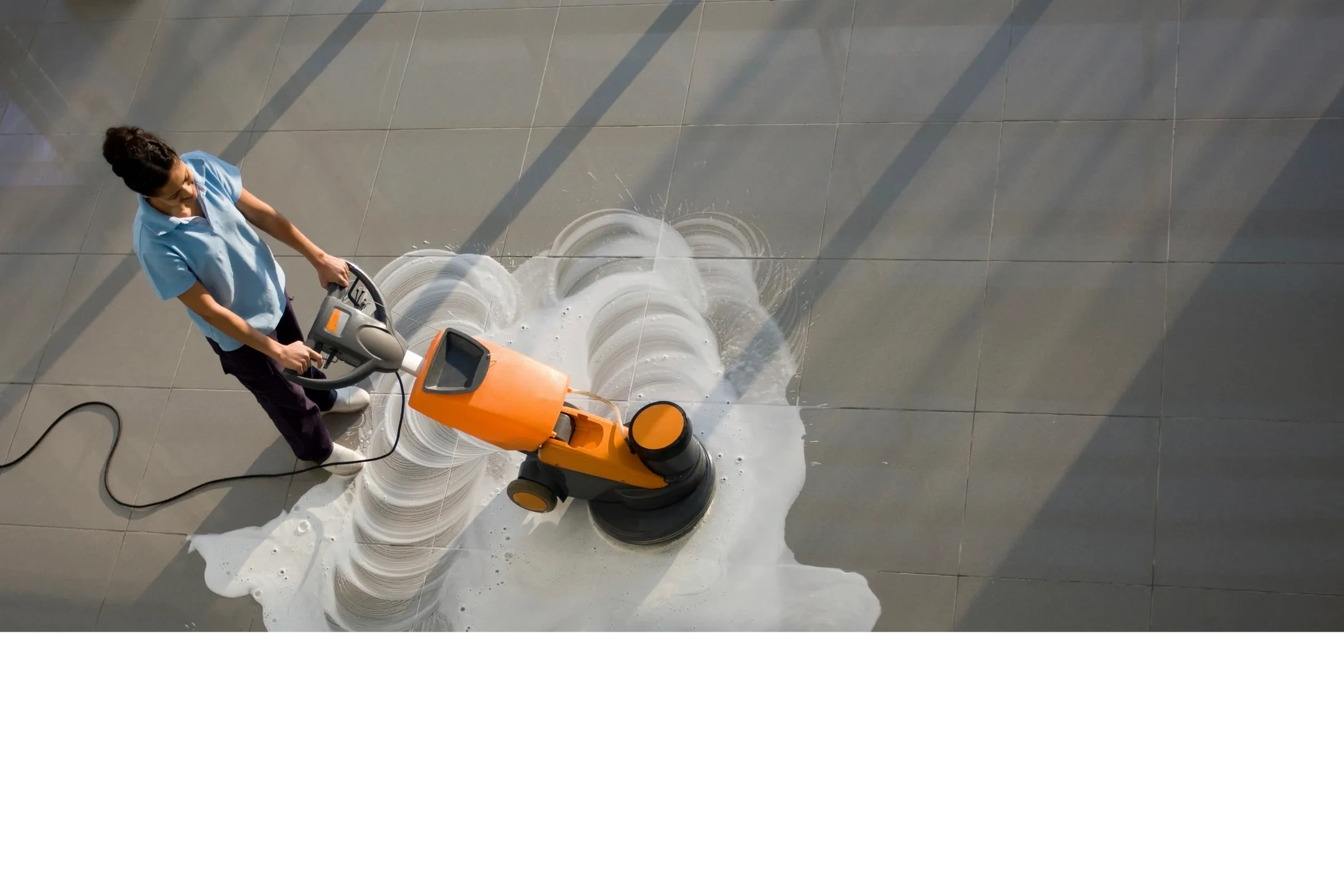
ESD & Static-Control Floor Cleaning
Las Vegas and Nevada are fast becoming a hub for data centers, electronics, and advanced manufacturing — and those facilities run on ESD (electrostatic-discharge) flooring that only protects equipment if it’s maintained correctly. The problem: most janitorial crews clean an ESD floor exactly the way they’d clean any other floor, and quietly destroy its ability to do its job. Green Clean cleans ESD and static-control floors the right way — to the standard they were installed to meet.
What an ESD floor does — and how cleaning breaks it
An ESD floor is engineered to carry static charge safely to ground. Conductive flooring measures roughly 2.5 × 10⁴ to 1 × 10⁶ ohms to ground; static-dissipative flooring, 1 × 10⁶ to 1 × 10⁹ ohms (per ANSI/ESD S20.20). All of that performance lives at the surface — and that’s where cleaning helps or hurts. A layer of dirt acts as an insulator and blocks the path to ground. Worse, the ordinary floor finishes and waxes most crews reach for are insulators too: a waxed ESD floor can still pass an ohms reading and yet fail the walking body-voltage test (ANSI/ESD STM97.2, the under-100-volt limit that actually defines compliance). In plain terms, a well-meaning crew using the wrong products can take a compliant floor out of compliance — and no one notices until equipment starts failing.
Every ESD floor type is cleaned differently — we know the difference
There is no single “ESD cleaning” procedure. The right method depends entirely on the floor:
- ESD vinyl tile — buffed with a specially formulated antistatic floor polish, never standard wax, and never the polyurethane “no-wax” coatings that actually generate static.
- ESD rubber — non-porous; periodic single-disc scrubbing and no finish at all, because any wax would simply insulate it.
- ESD carpet tile — routine vacuuming plus annual wet or dry extraction, keeping solvents and spills off the fiber.
- ESD epoxy and resinous floors — washed on a set cadence with the correct neutral cleaners, with no insulating build-up allowed to form.
We match the method and the products to your exact floor and its manufacturer’s specification, because the wrong product on the right floor is precisely how ESD performance gets destroyed.
Cleaning that protects your equipment and your floor’s performance
A discharge as small as 100 volts — you can’t even feel static until around 3,500 volts — can corrupt data, trigger latent component failures, and cause downtime. For any facility running an ESD-protected area to ANSI/ESD S20.20, the floor is part of that protection — so our job is to clean it without compromising its static-control performance. That means ESD-aware, low-moisture methods, the right products for your specific floor, and procedures coordinated with your ESD program and QA. If you ever want resistance verification or antistatic-finish service built into the program, we can coordinate that too.
Low-moisture methods that work around your sensors
Data-center floors have moisture and leak-detection sensors that the wrong cleaning can trip. We know how to work around them — we’ve developed low-moisture methods to clean your floor, for both routine maintenance and deep cleaning, without setting off alarms or putting water where it doesn’t belong.
Built for Las Vegas mission-critical facilities
Data centers and server rooms, electronics manufacturing and assembly, laboratories and cleanrooms, telecom and dispatch centers — the static-controlled environments growing fastest across the valley. It’s backed by Green Clean’s experience cleaning data-center and secure, mission-critical facilities and pairs with our data center cleaning and full commercial cleaning programs. (For standard VCT and hard floors that aren’t static-controlled, see our strip-and-wax and floor care — a different floor calls for a different process.)
Not sure your ESD floor is being cleaned correctly?
If you run an ESD-protected facility and you’re not certain your current cleaning is helping rather than hurting, that’s worth a conversation. We’ll walk the floor with you and give you a straight answer. Call 702.522.1898 or request a walkthrough below.